
Surya Namaskar benefits go beyond physical fitness and flexibility.
The sun has always held a special place in human life. Plants depend on sunlight for photosynthesis, ecosystems depend on the energy it provides, and human biological rhythms are influenced by the cycle of light and darkness.
It is therefore not surprising that ancient cultures developed rituals around the sun.
In India, the sun has been revered through different names, prayers, festivals, and spiritual traditions. Surya, the Sun, appears prominently in Hindu religious and yogic traditions.
Surya Namaskar, or Sun Salutation, brings together movement, breath, awareness, and, in traditional forms, mantra.
It is not simply a workout.
For many practitioners, it is also a way of beginning the day with gratitude and awareness.
What Is Surya Namaskar?
Surya Namaskar is a sequence of yoga postures traditionally performed in a flowing order.
A commonly taught sequence contains 12 positions, although the exact sequence and naming can vary between yoga traditions and schools.
Traditional versions may also incorporate specific mantras associated with the Sun.
The 12 positions create a rhythmic movement between forward and backward, expansion and contraction, strength and flexibility.
When coordinated with breathing, the practice becomes more than a collection of individual poses.
It becomes a moving sequence.
This is one reason Surya Namaskar can feel both physically active and mentally grounding.
The practice also has a spiritual dimension.
The Sanskrit word Surya means Sun, while Namaskar refers to offering respect or salutation.
So, traditionally, the practice can be understood as a salutation to the Sun.
For some people, this is a religious practice.
For others, it is a physical yoga sequence.
And for some, it is both. Yoga is traditionally understood as a broader practice involving physical postures, breathing, concentration, and meditation, rather than exercise alone. The National Center for Complementary and Integrative Health provides an overview of yoga and its potential health benefits.
My Personal Experience With Surya Namaskar
I have been practicing Surya Namaskar for five years.
One of the things I personally appreciate most about it is how little equipment it requires.
You don’t need a complicated setup.
You don’t need a gym.
You don’t even need a long workout.
A few rounds can become a simple way to move the body, coordinate breathing, and create a deliberate beginning to the day.
The physical practice involves repeated transitions between different positions, which means several major muscle groups are engaged throughout the sequence.
It also requires coordination.
You have to remember where your hands and feet go, coordinate movement with breathing, and maintain enough awareness to move safely.
For me, that combination is what makes the practice interesting.
It is movement, but it is also attention.
What Are the Benefits of Surya Namaskar?
Research on Surya Namaskar has explored several areas, including physical fitness, flexibility, strength, cardiovascular responses, and psychological well-being.
However, the amount and quality of evidence vary, so it is better to describe Surya Namaskar as a form of physical activity and yoga practice with potential benefits, rather than as a treatment for specific diseases.
1. Physical Movement
Surya Namaskar moves the body through multiple positions.
Depending on how it is performed, the sequence can involve:
- Shoulders
- Arms
- Chest
- Back
- Core
- Hips
- Legs
- Ankles
Repeated practice can contribute to mobility, muscular endurance, coordination, and flexibility.
The intensity also depends on how quickly you perform the sequence.
A slow practice may feel more like controlled mobility work, while a faster practice can become considerably more cardiovascular.
2. Flexibility and Mobility
Several positions in Surya Namaskar involve bending, reaching, extending, and shifting weight between different parts of the body.
Regular yoga practice has been associated with improvements in flexibility and physical function, although results depend on the type, duration, and frequency of practice.
Surya Namaskar can therefore be a convenient way to incorporate movement into a morning routine.
3. Strength and Muscular Endurance
Some versions of the sequence require the body to support itself through positions such as plank-like transitions, Ashtanga Namaskara, and Bhujangasana.
Repeated rounds can therefore challenge muscular endurance.
How demanding the practice feels will depend on your technique, pace, number of rounds, and current fitness level.
You don’t have to perform dozens of rounds to benefit from moving your body.
4. Coordination and Focus
Surya Namaskar asks you to coordinate three things:
Movement + Breath + Attention
If you’re thinking about something completely different, it becomes easy to lose track of the sequence.
This makes the practice an interesting form of moving mindfulness.
You are not simply moving your arms and legs.
You are noticing:
Where am I placing my foot?
When am I inhaling?
When am I exhaling?
Is my posture comfortable?
That repeated attention can make the practice feel mentally grounding.
If you enjoy this aspect, you can also explore Mindfulness Journey: Build Spiritual Awareness Without Religion.
Daily Practice of Surya Namaskar
The best number of rounds depends on the individual.
There is no universal rule saying that every person must perform 12, 24, or 108 rounds.
Your current fitness, age, flexibility, injuries, health conditions, and experience all matter.
For a beginner, 2 or 3 comfortable rounds can be enough to learn the sequence.
Once you become comfortable with the movements, you can gradually increase the number if your body responds well.
The goal should not be:
“How many rounds can I survive?”
It should be:
“How consistently can I practice while maintaining good technique?”
Surya Namaskar for Different Age Groups
The original version of this article gives specific recommendations for children, teenagers, and middle-aged adults.
I would avoid presenting fixed round counts as universal prescriptions.
Children and teenagers may have very different physical abilities from one another.
Adults may also have very different fitness levels, injuries, health conditions, and previous experience.
A better approach is to adjust the practice according to the individual.
Beginners
Start with 2 to 3 slow rounds.
Focus on learning the sequence and coordinating breathing with movement.
Intermediate practitioners
You can gradually increase the number of rounds and experiment with different speeds.
Experienced practitioners
More rounds may be appropriate if the technique remains controlled and the practice fits your physical capacity.
You can combine Surya Namaskar with pranayama, meditation, or Yoga Nidra if that is already part of your routine.
Precautions Before Practicing
Surya Namaskar is physical exercise, so it is important to respect your body’s limits.
If you have a significant medical condition, recent injury, severe back or joint problems, cardiovascular concerns, or other health issues, speak with an appropriate healthcare professional before beginning or significantly increasing your practice.
During the practice:
- Don’t force a stretch.
- Don’t hold your breath unnecessarily.
- Don’t rush through transitions.
- Stop if you experience significant pain, dizziness, chest pain, or unusual breathlessness.
- Modify poses when necessary.
- Learn proper technique before increasing speed or repetitions.
Should you practice on an empty stomach?
Many yoga traditions recommend practicing Surya Namaskar on an empty or relatively light stomach.
From a practical perspective, vigorous movement immediately after a large meal can be uncomfortable.
If you have eaten a substantial meal, giving yourself enough time to digest before practicing may make the experience more comfortable.
The 12 Steps of Surya Namaskar
Traditional Surya Namaskar practices often associate each of the 12 positions with a Sanskrit mantra connected to Surya.
The exact sequence and terminology can vary across yoga traditions, so the following represents the traditional structure used in this practice.
1. Pranamasana | Prayer Pose
Stand upright with your feet together or comfortably aligned.
Bring your palms together near the heart.
The associated mantra is:
Om Mitraya Namah
Mitraya is traditionally associated with the friendly or benevolent one.
The position creates a moment of stillness before movement begins.
2. Hasta Uttanasana | Raised Arms Pose
Raise your arms upward and gently extend through the upper body.
Avoid forcing the lower back into an excessive bend.
The traditional mantra is:
Om Ravaye Namah
Ravi is associated with the radiant or shining one.
3. Padahastasana | Hand-to-Foot Pose
Fold forward from the hips as comfortably as possible.
Allow the head and neck to relax.
Don’t worry if your hands cannot reach the floor.
The mantra is:
Om Suryaya Namah
Surya refers to the Sun.
4. Ashwa Sanchalanasana | Equestrian Pose
Step one leg backward while bringing the other foot forward.
Lift the chest and maintain a comfortable position.
The traditional mantra is:
Om Bhanave Namah
Bhanave is associated with the one who illuminates.
5. Parvatasana | Mountain Pose
Move into the mountain or downward-facing position used in the sequence.
Press through the hands while lengthening the spine.
The mantra is:
Om Khagaya Namah
Khaga is traditionally associated with the one who moves through the sky.
6. Ashtanga Namaskara | Eight-Point Salute
Lower the body so that traditionally eight points make contact with the ground.
The mantra is:
Om Pushne Namah
Pushan is associated with nourishment and sustenance.
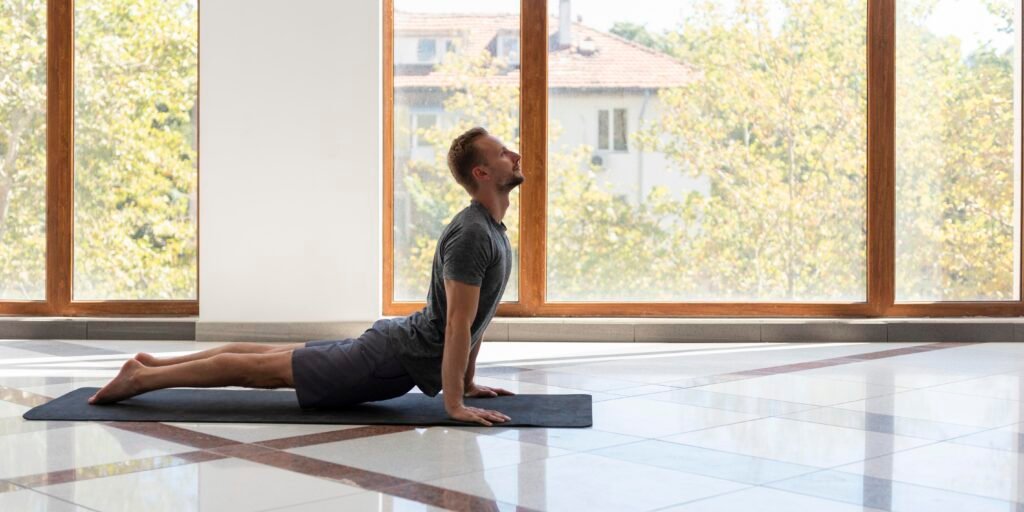
7. Bhujangasana | Cobra Pose
Move forward and gently lift the chest into Cobra Pose.
Keep the movement controlled and avoid forcing the lower back.
The mantra is:
Om Hiranyagarbhaya Namah
Hiranyagarbha is traditionally translated in connection with the “golden womb” or cosmic source.
8. Parvatasana | Mountain Pose
Return to the mountain position.
Lengthen through the spine and settle into the posture without forcing the heels toward the floor.
The mantra is:
Om Marichaye Namah
Marichi is associated with rays of light.
9. Ashwa Sanchalanasana | Equestrian Pose
Bring the opposite leg forward.
This balances the sequence by working both sides of the body.
The mantra is:
Om Adityaya Namah
Aditya refers to the Sun and is traditionally associated with the sons of Aditi.
10. Padahastasana | Hand-to-Foot Pose
Bring the other foot forward and fold into the forward bend again.
Allow the movement to remain comfortable.
The mantra is:
Om Savitre Namah
Savitr is a traditional solar deity associated with stimulation and vitality.
11. Hasta Uttanasana | Raised Arms Pose
Rise upward and extend the arms.
Keep the movement controlled rather than forcing a deep backbend.
The mantra is:
Om Arkaya Namah
Arka is another traditional name associated with the Sun.
12. Pranamasana | Prayer Pose
Return to the standing position with the palms together.
The final mantra is:
Om Bhaskaraya Namah
Bhaskara is associated with the one who creates or gives light.
One complete cycle is now finished.
Why Are There 12 Positions?
The number 12 has an obvious connection with the solar year and the 12 months commonly used in the calendar.
Traditional explanations also associate the 12 mantras with different names or aspects of Surya.
However, the exact historical development of the modern Surya Namaskar sequence is more complicated than simply saying that the sequence has existed unchanged since ancient times.
Different schools and traditions teach different versions.
So the most useful way to understand the 12-step sequence is as a traditional yogic practice that has developed through different lineages, rather than assuming there is one universally identical ancient sequence.
How Long Does Surya Namaskar Take?
You don’t need to spend an hour.
For a beginner:
3 rounds → around 5 to 10 minutes
Depending on your pace, experience, and rest periods, more rounds can take longer.
The important thing is consistency.
Five mindful minutes performed regularly can be more realistic than planning an elaborate one-hour routine and abandoning it after three days.
Surya Namaskar Is More Than Exercise
For me, this is the part that makes Surya Namaskar different.
You begin standing.
You fold.
You move forward.
You move backward.
You lower yourself.
You rise again.
And eventually, you return to exactly where you started.
The physical sequence becomes a small daily reminder that movement doesn’t always have to be about achievement.
Sometimes it can simply be about showing up.
The traditional practice adds another layer through gratitude toward Surya.
Whether you approach that spiritually, symbolically, or simply as a mindful morning ritual is up to you.
Final Thoughts
Surya Namaskar is not just an exercise.
For many practitioners, it is a conversation with the sun, with the body, and with the present moment.
Five years of practice have taught me that the most important round is often the first one:
The one you do even when you don’t feel like starting.
You don’t need to begin with 12 rounds.
Start with 3.
Learn the movements.
Coordinate them with your breathing.
Pay attention to how your body feels.
Then let your practice grow naturally.
You can finish a short session in the morning and carry that sense of movement and attention into the rest of your day.
And if you want to combine movement with deeper relaxation, explore Yoga Nidra next.

Pingback: 5 Pranayama "Algorithms" to Calm Your Mind Fast